
Privacy Screens for Coastal Newcastle Homes
Salt air, coastal winds, and UV exposure are realities that homeowners in Merewether, Bar Beach, Newcastle East, and Redhead deal with every single day. The materials that work fine twenty kilometres inland don’t always hold up the same way when they’re sitting a few streets back from the ocean.
Aluminium is the standout performer in coastal conditions. Powder-coated aluminium screens resist corrosion, hold their colour under intense UV, and need almost nothing in the way of ongoing maintenance — which is exactly what a coastal homeowner wants. The coating acts as a genuine barrier against the salt-laden air that accelerates deterioration in lesser materials.
Timber and steel can absolutely work near the coast, but material selection and finish quality matter more the closer you are to the water. Treated hardwoods with the right oil or sealant perform well in coastal garden settings, and steel with quality protective coatings holds up fine for most applications. We advise on the right material for your specific location as part of every consultation — because a screen that degrades in three years isn’t a solution.

Where Privacy Screens Make the Biggest Difference
Every outdoor space has its own set of challenges, and a well-positioned screen addresses them precisely where they exist.
- ✅ Pool & Spa Areas — Your pool zone should feel like a private retreat, not a fishbowl. A screen built around the actual sightline gives you full seclusion without enclosing the space entirely, keeping it open and connected to the rest of the backyard.
- ✅ Alfresco & Outdoor Entertaining Areas — Elevated neighbouring properties and two-storey homes are a reality across Newcastle’s established suburbs. A purpose-built screen targeted at the exact viewing angle turns your entertaining area into the space it was always supposed to be.
- ✅ Service Areas & Utility Zones — Bins, air conditioning units, and hot water systems don’t need to be part of the view. A screen tucks them away cleanly and keeps the visual focus where it belongs.
- ✅ Internal Yard Division — Separate zones make a backyard work harder for everyone. A children’s play area screened from an adult entertaining space gives the whole family their own corner.
How Spacing & Orientation Affects Privacy and Light
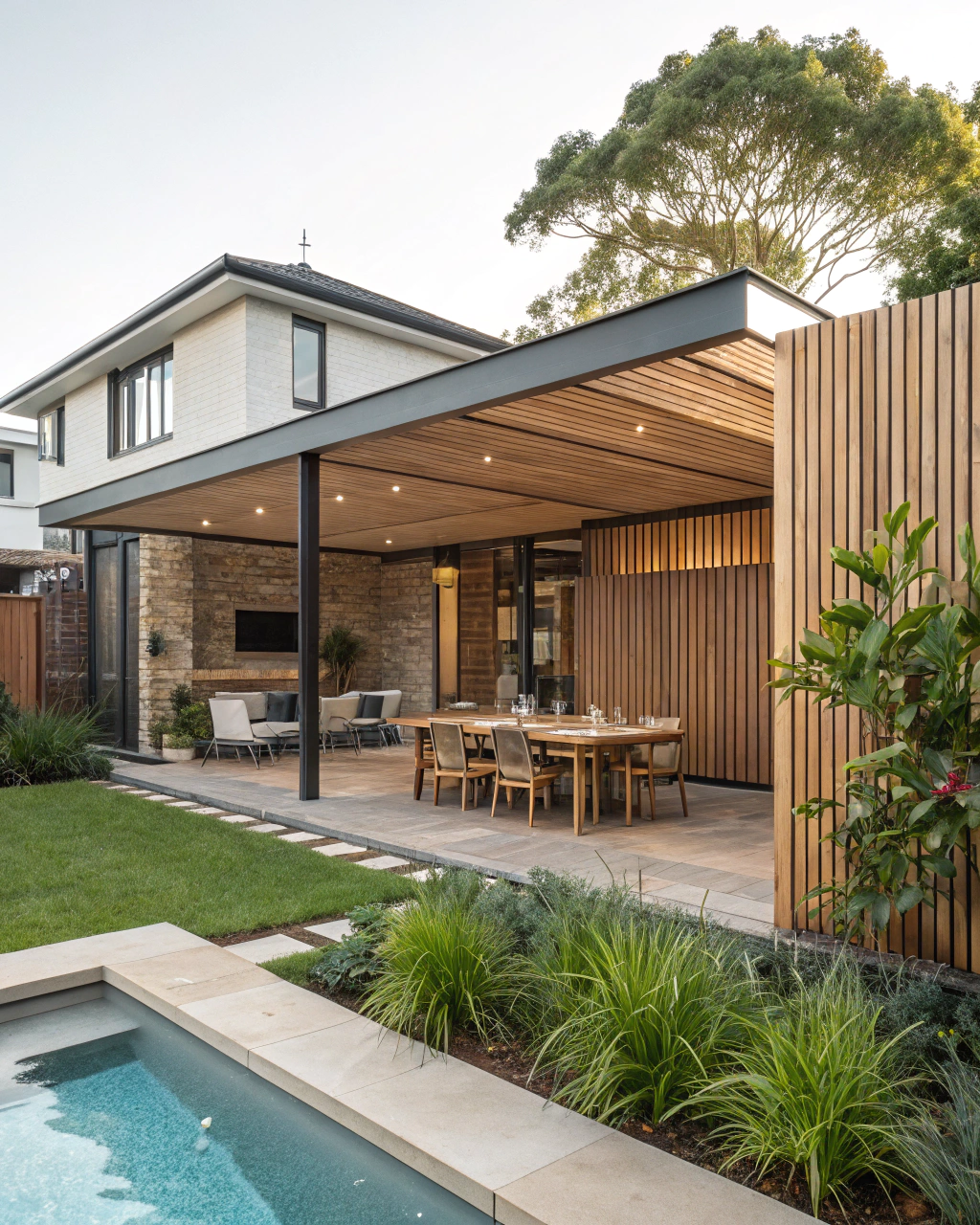
One of the most common misconceptions about privacy screens is that more solid means more private. It’s not always that straightforward. A screen with tighter batten spacing will block more direct sightlines, but it also reduces light filtration and airflow through the space — which may or may not be what the site actually needs.
The angle the screen faces relative to the sightline matters just as much as the spacing. A screen that sits parallel to the viewing angle delivers far less privacy than one oriented to intercept it directly. Getting that orientation right is something that only comes from properly assessing the site rather than installing a screen and hoping the geometry works out.
Batten depth and projection also play a role — a deeper batten creates shadow and visual interruption at certain angles while still allowing light and air to move through the screen freely. The right combination of spacing, orientation, and batten profile gets designed around the specific conditions of each site.
Custom Privacy Screen Design for Newcastle Homes
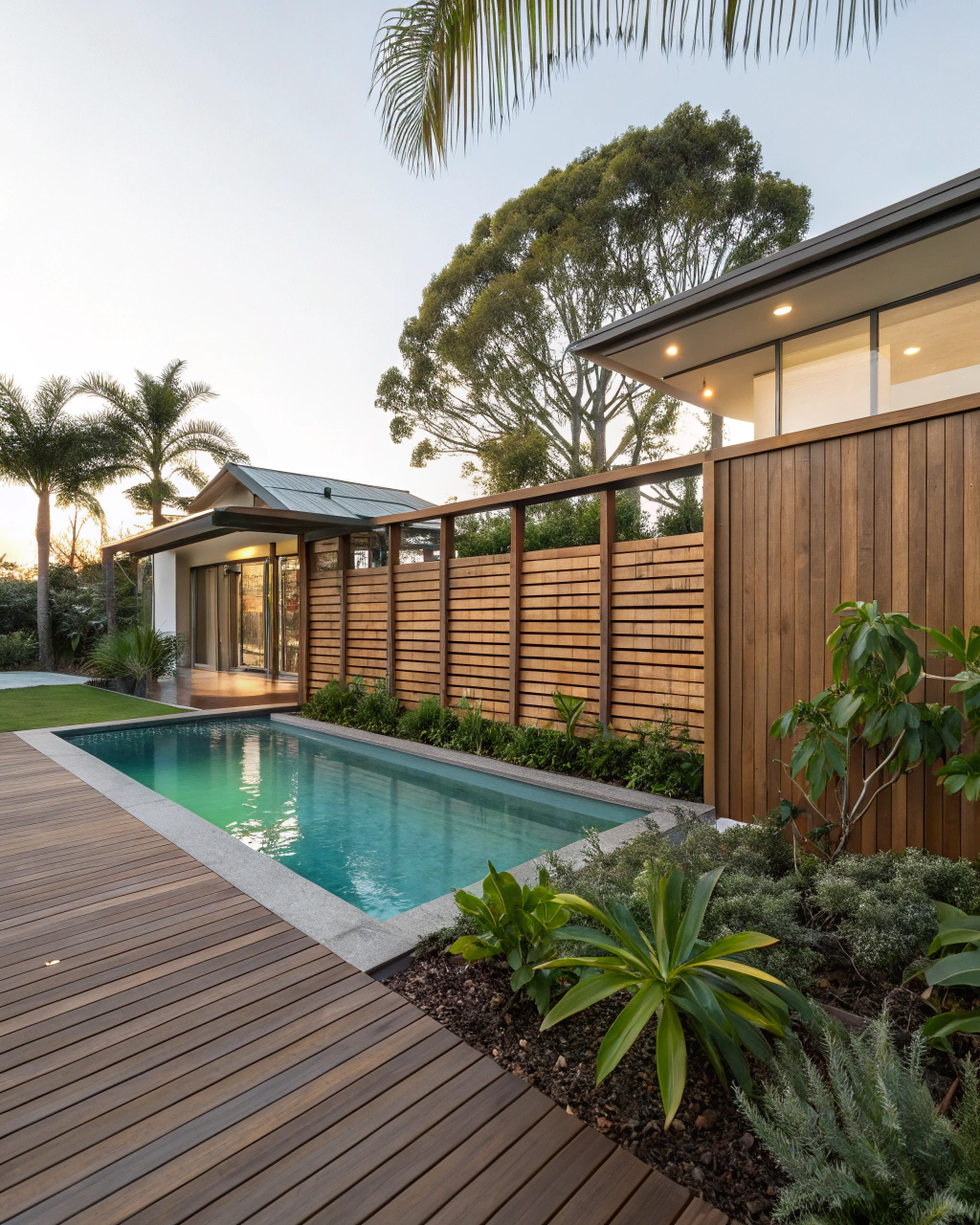
No two sites are the same, and no two privacy problems are identical. A screen that works perfectly for a Merewether homeowner dealing with an elevated neighbour to the north looks completely different to one built for a Kotara backyard where the issue is a side boundary overlooked by a neighbouring deck.
That’s why every screen we design starts with a proper on-site assessment. We look at where the sightline problem actually exists, what height and width the screen needs to be to address it, how the structure will integrate with existing fencing, decking, or landscaping, and what materials suit both the site conditions and the home’s architectural style.
From there, the design gets built around those specifics — not pulled from a standard range and modified to fit. The result is a screen that solves the actual problem, holds up to Newcastle’s conditions long-term, and looks like it belongs on the property rather than bolted on as an afterthought.
Privacy Screens That Work With Existing Landscaping
Most backyards that need a privacy screen already have something going on — established garden beds, mature plantings, existing paving or decking, maybe a retaining wall or two. The screen needs to work with all of that, not fight against it or require pulling everything out to make room.
Timber screens sit naturally in garden settings. Batten spacing that allows light through encourages the plantings in front of or behind the screen to keep performing, and the warmth of the timber material ties the structure back to the garden rather than sitting in contrast to it.
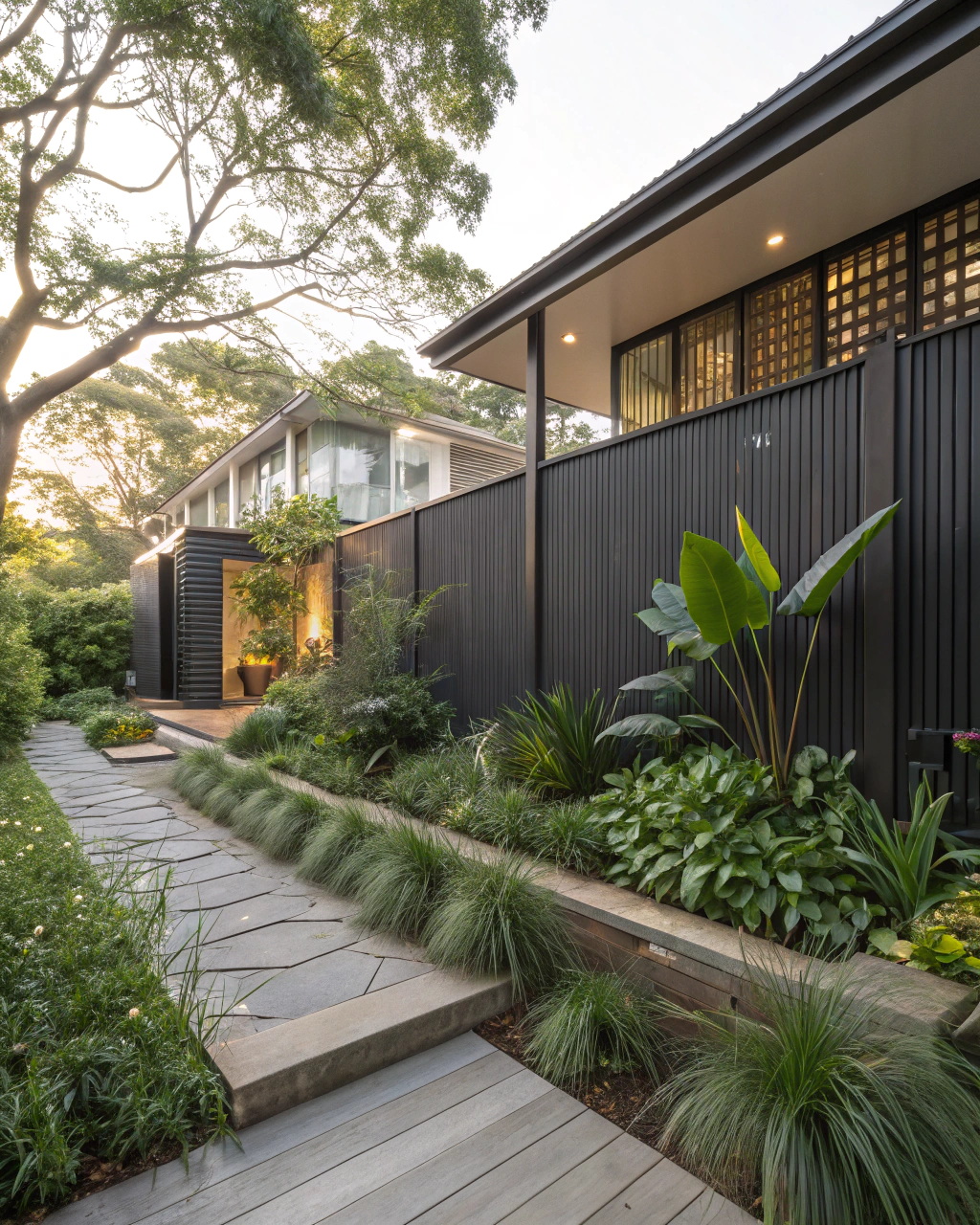
Aluminium screens in darker powder-coat finishes — charcoal, black, deep grey — work as a backdrop that makes planting pop rather than competing with it. The clean lines of an aluminium screen against a well-planted garden bed are one of the more effective combinations in contemporary Newcastle outdoor design.
The screen gets designed with the existing landscape in mind from the start, not retrofitted around it afterwards.
Structural Design & Wind Load Considerations
| Post Sizing & Footing Depth | Panel Fixing for Coastal Conditions |
|---|---|
| A privacy screen that looks great on day one but shifts, leans, or fails in the first big storm isn’t a solution — it’s a liability. Taller screens and larger panels generate significant wind load, and that load needs to go somewhere. Post sizing and footing depth get calculated based on the screen’s dimensions, the site’s exposure, and the soil conditions underfoot. Newcastle’s coastal suburbs see genuine wind events, and every structural decision we make accounts for that from the beginning. | Fixing the panels to the frame correctly is just as important as getting the posts and footings right. In coastal conditions, the hardware and fixing method matters — the wrong fasteners corrode, loosen, and fail well before the screen itself shows any sign of wear. We use fixing systems suited to Newcastle’s salt-air environment, specified for the panel weight and wind load the screen will experience. The result is a screen that stays exactly where it was built, year after year, without needing attention every time the weather turns. |
Boundary Screening Solutions Beyond the Standard Fence
A standard fence does a standard job. It marks the boundary, delivers a baseline level of privacy, and satisfies council requirements. But for a lot of Newcastle homeowners, a standard fence isn’t enough — particularly when the neighbouring property sits higher, when the fence line runs directly beside an entertaining area, or when the existing boundary structure is functional but visually unremarkable.
A purpose-built boundary screen goes further. It can be built taller where the site and council requirements allow, designed with batten profiles and materials that complement the home’s architecture, and positioned to address the specific sightline rather than simply running the full length of the boundary. The result is a boundary treatment that actually solves the privacy problem rather than partially addressing it.
Boundary screens also add genuine visual character to an outdoor space. A well-designed timber or aluminium screen along a boundary wall becomes part of the outdoor room — a backdrop to planting, a feature in its own right, and a structure that lifts the overall presentation of the property rather than just blocking the neighbour’s view.
How We Assess Sightlines Before Designing Your Screen
Getting the sightline assessment right is what separates a screen that actually works from one that looks good on paper but misses the viewing angle by half a metre and delivers no practical benefit.
The assessment starts on site. We look at where the overlooking is coming from — the neighbouring window, the elevated deck, the upstairs balcony — and work out the exact angle that needs to be intercepted. That tells us the height the screen needs to reach, the horizontal position it needs to occupy, and how far it needs to extend to close off the sightline without over-building.
We also look at what’s already on the site — existing fencing, structures, planting, and levels — because all of those affect both where the screen can go and how it needs to be built to perform properly.
The design that comes out of that assessment is specific to that site and that problem. Nothing gets assumed, nothing gets guessed, and nothing gets left to chance.


Privacy Screen FAQs
Generally, screens up to 1.8 metres can be built without development approval, but position on the block and proximity to boundaries affects this. We assess your specific site and advise on the approval pathway during the initial consultation.
Powder-coated aluminium is the strongest performer in coastal conditions — it resists corrosion, holds its colour under UV, and needs minimal maintenance. Timber and steel can work well too, but material selection and finish quality matter more the closer you are to the water.
That’s exactly what our on-site sightline assessment determines before anything gets designed or built. We identify the exact viewing angle, calculate the height and position the screen needs to occupy, and design around that — not around a standard size.
Yes, provided it’s properly engineered. Post sizing, footing depth, and panel fixing all get calculated based on the screen’s dimensions and the site’s wind exposure. Coastal conditions are factored into every structural decision we make from the beginning.
A well-built timber screen using quality treated hardwood, finished correctly and maintained periodically, will perform for fifteen to twenty-plus years in most Newcastle conditions. Proximity to the coast affects longevity, which is why timber selection and finishing are discussed during the design process.
Get a Free On-Site Assessment for Your Privacy Screen
If your outdoor space feels more exposed than it should, the best first step is a proper on-site assessment. We come to you, look at the actual sightline problem, and give you a clear picture of what the screen needs to do, what it will look like, and what it will cost — before any commitment is made.
We build custom privacy screens across Newcastle, the Hunter Region, and surrounding areas. Timber, aluminium, and steel. Every screen is designed around the specific site and the specific problem.
Call us today or fill in the quote form to book your free on-site assessment. The conversation costs nothing, and you’ll walk away knowing exactly what the solution looks like.